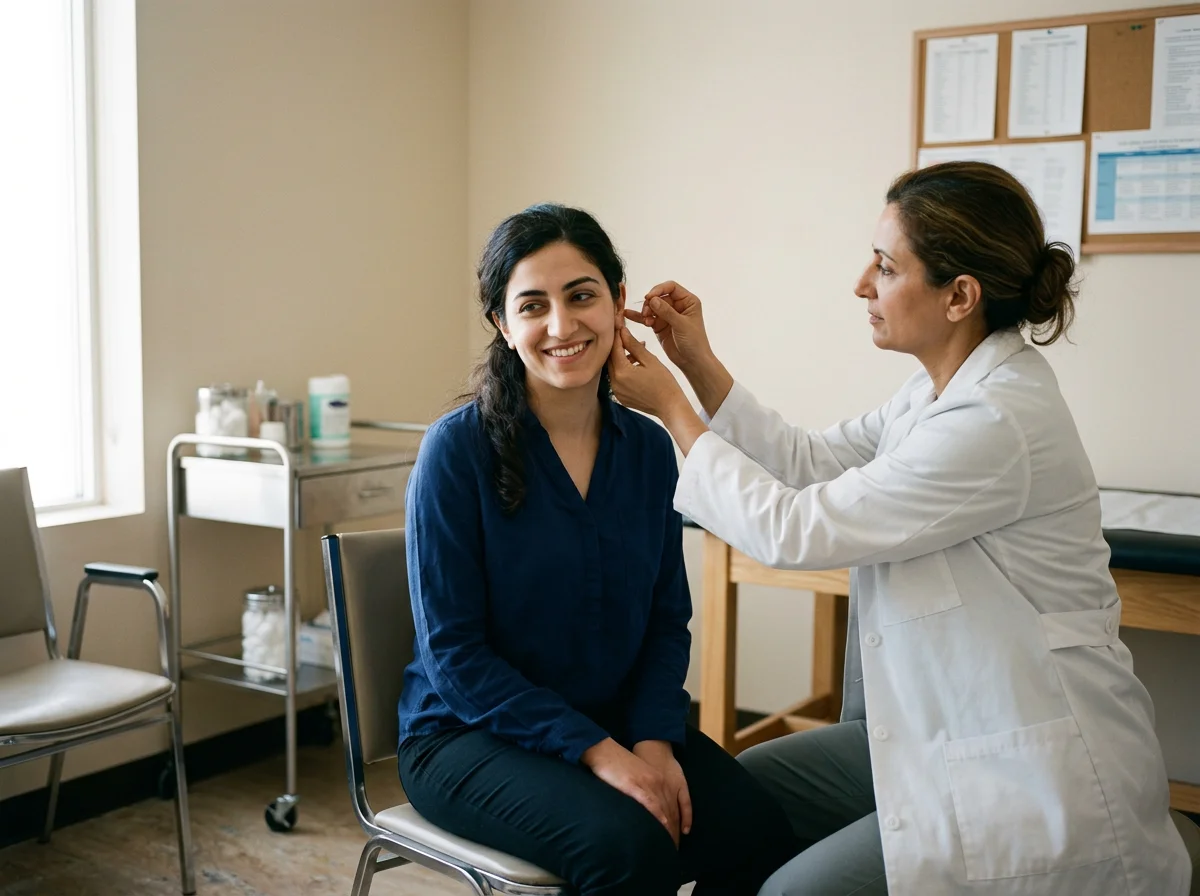
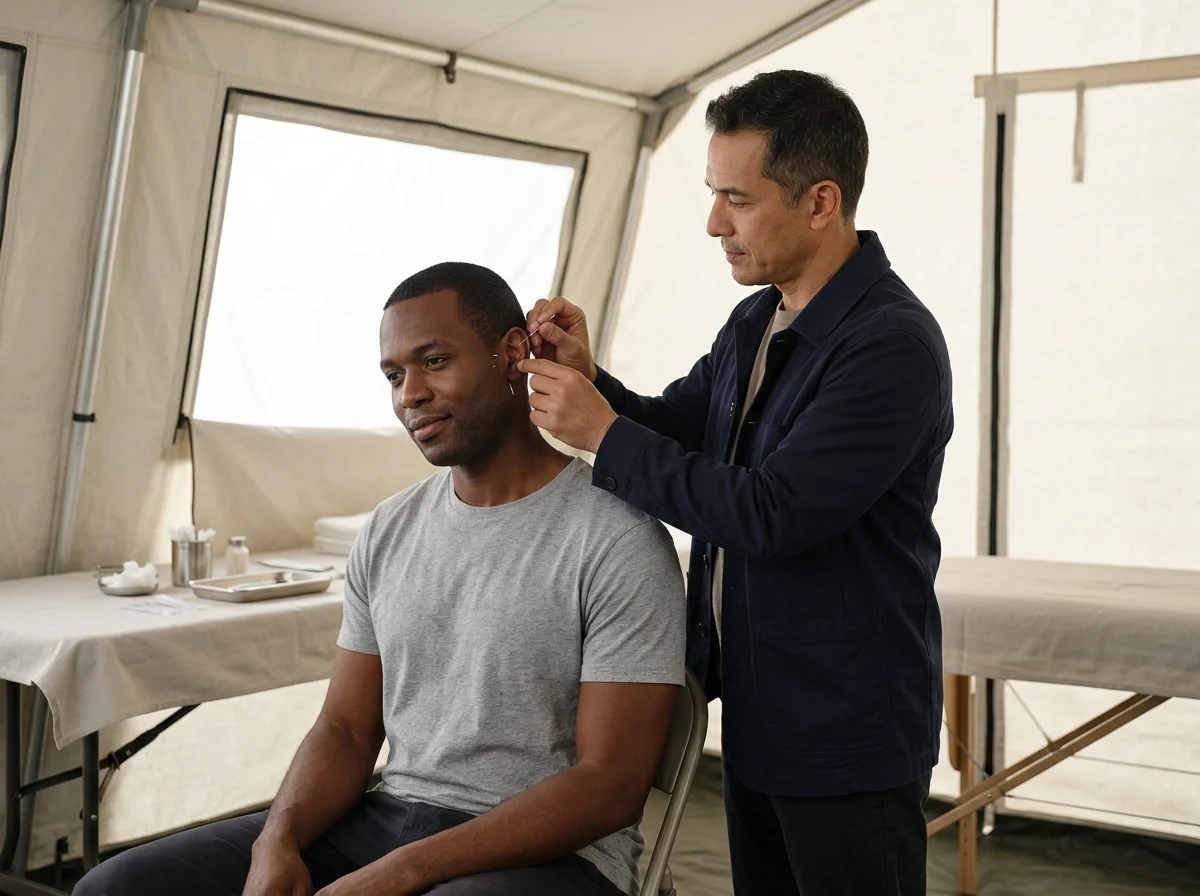
The practice of treating the body through the ear is among the oldest strands of Chinese medicine. The Huangdi Neijing (The Yellow Emperor's Classic of Internal Medicine), the foundational text of the tradition, describes the ear's connection to the channels of the body and records early ear-based techniques, including bloodletting from distended vessels near the ear and blowing air into the ear to revive an unconscious patient. Chinese medical sources hold that the ear connects, directly or indirectly, with the twelve channels, so that stimulating it can restore balance between qi and blood. Later physicians continued the tradition. From the Tang dynasty onward, for instance, moxibustion at the tip of the ear was used to move blood and harmonize yin and yang. In 1888, Zhang Zhenjun published what is considered the first auricular map in China, in his massage text Lizheng Anmo Yaosu. It showed regions of the back of the ear corresponding to the heart, liver, spleen, lung, and kidney.
The modern form of ear acupuncture took shape in France in the 1950s. Dr. Paul Nogier, a physician in Lyon, noticed that patients treated for sciatica by a folk practitioner in Marseille had scars from cauterization on a particular spot of the ear. Cauterizing the ear for sciatica had a long history around the Mediterranean, and French medical journals had reported such cases in the nineteenth century. Nogier investigated systematically and in 1956 presented his finding that the ear maps the whole body, arranged like an inverted fetus, with the head at the lobe and the spine along the antihelix. Chinese acupuncturists read his 1957 publication, which was translated into Chinese in 1958 and 1959. Chinese clinicians then combined it with their own classical framework, developing several distinct schools of ear acupuncture and formalizing standardized point charts.
From this lineage came the simple protocols used in humanitarian work today. In the 1970s, clinicians at Lincoln Hospital in the Bronx developed a standardized five-point ear protocol for addiction treatment, which became the NADA protocol. Because it is brief, uses only a few points, and can be taught to non-specialists, it spread into disaster relief, refugee care, and trauma recovery. Battlefield Acupuncture, developed by U.S. Air Force physician Richard Niemtzow, later adapted ear acupuncture for rapid pain relief in military and veteran care. The Scarlet Oak Collective builds on this history, drawing on a technique with roots in classical Chinese medicine, refined in modern clinical practice, and suited to being delivered by trusted, local hands.